




You have a process to automate, and after hearing so much about AI, the first question that comes to mind is: should we do this with an AI agent? Before saying yes, ask yourself the real question: what are we hoping to gain? And what are we willing to lose in exchange?
The arrival of AI agents is changing how companies approach automation. Where traditional automation runs a process defined in advance, an AI agent can interpret a situation, reason, choose an action, and so on.
To keep things simple, we’ll use the term “traditional automation” to cover both robotic process automation (RPA) and automations built directly in the back end.
I often see tables like this one pass by on social media or at conferences:
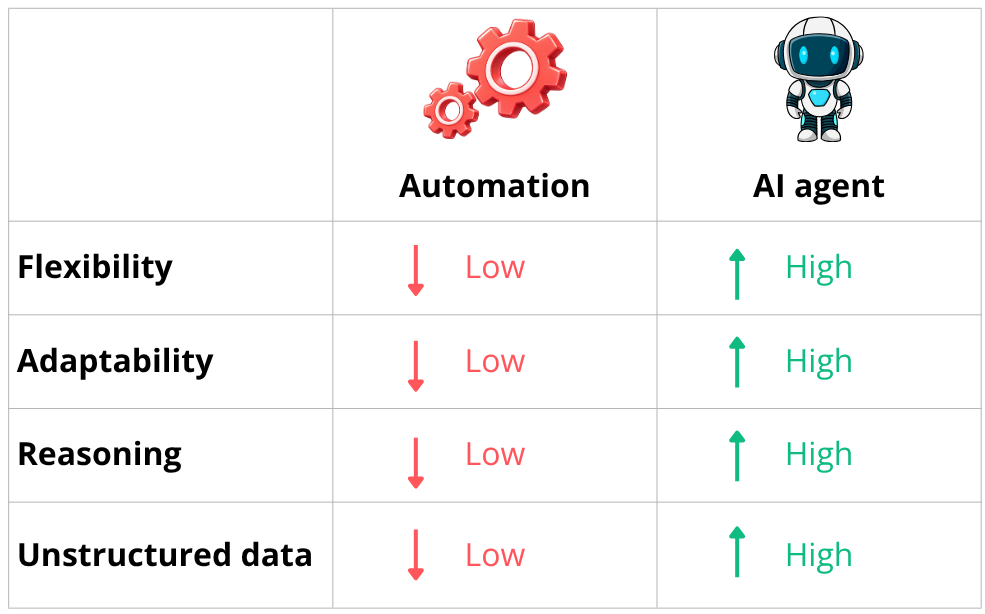
Presented like this, the choice seems obvious: AI agents are the evolution of traditional automation and should be the go-to.
But this comparison misses one essential thing: flexibility and adaptability come at a cost. The more latitude you give a system to interpret a situation and decide, the less you can predict what it will do (its behavior is less deterministic and reproducible), and so the risk of error goes up. For example, if you give an AI agent the exact same task twice, you’re not guaranteed to get the exact same answer.
So we should also add:
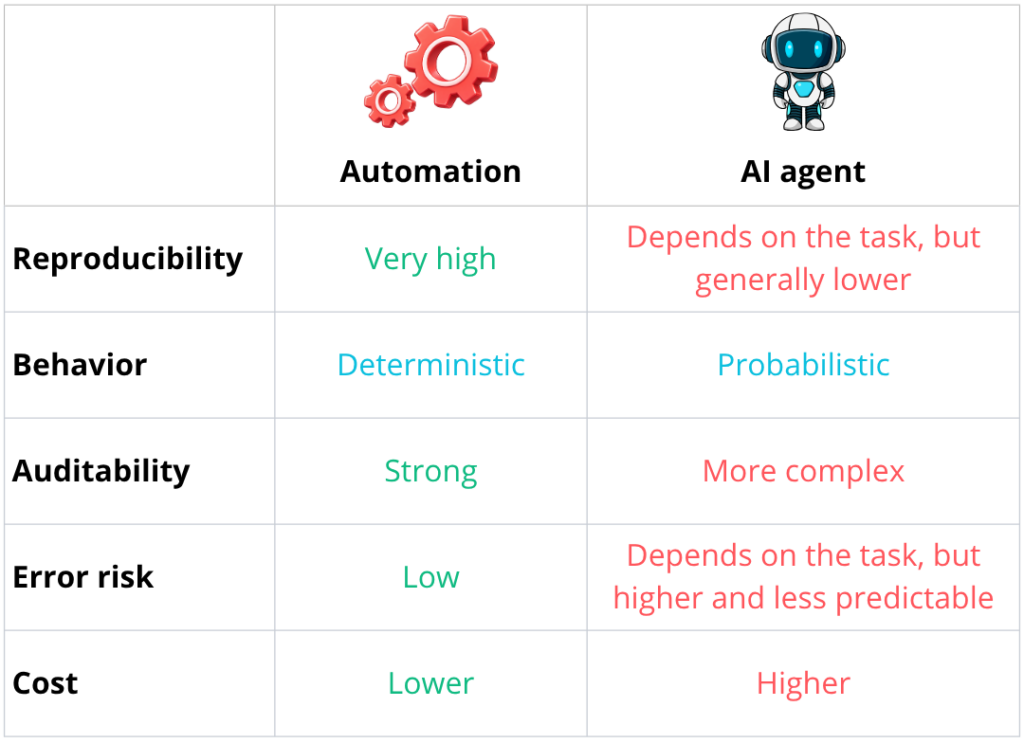
To know whether the AI agent is “better,” we should ask instead:
Where do we need flexibility and reasoning, and where do we need standardization and reproducibility?

Traditional automation relies on explicit rules and a sequence known in advance. It’s like a recipe:
When the steps and the ingredients are identical, you always get the same result. We say the behavior is reproducible and predictable (deterministic).
This is especially relevant for repetitive tasks, stable processes, and operations where you want to be able to explain exactly why an action was taken. It makes testing, incident explanations, audits and transparency much easier. Its consistency also guarantees a certain kind of fairness, since identical cases will always be treated the same way. No surprises!
That rigidity, or transparency, obviously comes at a price. Every unplanned scenario becomes an exception to code, which means more code to write and maintain.

An AI agent works more like a head chef. You give it a goal and tools rather than a sequence of instructions. For example: “make a meal that tastes good and will help me build muscle, using the following ingredients and utensils.” It looks at what it has on hand, thinks it through, and adjusts as it goes. The agent can interpret the available information, decide on the next step, call an API or a tool, observe the result, then adapt its behavior until it reaches its goal.
Let’s take an email received by customer support:
“We received only four of the six devices we ordered (order #3242329) and would like a follow-up.”
An AI agent can:
You can see the potential of AI agents!
But that ability to interpret also means part of the process is now left to the model’s judgment. So we need to think not only about what the agent can do, but also about what it should (or shouldn’t) be allowed to do on its own.
AI agents do have real advantages: they can automate situations that rigid rules struggle to handle. They can understand natural language, reason across multiple sources and adapt to significant variations.
But the overall conclusion remains the same: if you need reproducibility (determinism) without needing flexibility or reasoning, traditional automation is the right fit. Conversely, a situation where understanding context and reasoning matter will most likely call for an AI solution.
Can you list every possible case or rule in advance? The agent becomes especially interesting when the exceptions or possibilities are too numerous, or when the sequence of steps isn’t known upfront.

Approaches like agentic workflows or AI-augmented automation combine a bit of both worlds. The overall flow stays structured and predictable, but calls to an LLM (AI) can be built in at specific moments to interpret, extract information from unstructured data, reason, or handle more complex situations.
You get the flexibility of AI while keeping some of the reproducibility and control of traditional automation.
Let’s go back to our five-step recipe and see exactly where AI fits in.
| Step | Approach | Why? |
| 1. Retrieve the email | Traditional | A webhook does the job. No judgment required. |
| 2. Validate the format | Traditional, with an optional AI call | A regular expression checks the syntax. AI can also flag likely typos like gmial.com, but it isn’t necessary. |
| 3. Copy into the CRM | Traditional | No reason to use AI here. |
| 4. Save the result | Traditional | No reason to use AI here. |
| 5. Choose the promotion | Guardrailed AI call | An interesting use: AI picks the most relevant offer based on purchase history, but from a pre-approved catalog, without being able to invent one. |
| 6. New! Extract information from the email and enrich the data | AI | AI can be used to enrich the data. For example, extract the domain from the user’s email address, then use AI to create variables: is it a personal or work address? If it’s a work address: company name, headquarters location, company size, industry, etc. |
That last step deserves a closer look, because it only exists thanks to AI; steps 1 to 5 were already there. When you bring in AI, it’s a chance to rethink your processes! New features become affordable and accessible.
The goal shouldn’t be to maximize the use of AI, even if the pressure is pushing many organizations in that direction. For the best results and ROI, you need to think about the business need, find the best method to solve the problem, and use AI where it truly adds something.
The secret is in picking the best approach for each task: sometimes it will be traditional automation, sometimes an autonomous AI agent, and other times a hybrid combination!
A poorly suited approach can lead to more errors, maintenance, costs or complexity, while a well-chosen architecture strikes a better balance between reliability, flexibility and performance.
Have a process to automate but not sure which approach to take?